Township Living vs Standalone Apartments: Which Is
Introduction
Choosing a home isn't just about picking four walls and a roof anymore. It's about deciding what kind of life you want around those walls. Do you want a gated community with parks, schools, and a clubhouse within walking distance? Or do you prefer a simple, independent apartment building where you keep to yourself and step out only when you need to?
This is exactly the dilemma most homebuyers face today: township living versus standalone apartments. Both options have loyal fans, and both come with real trade-offs. One offers a ready-made community and a bundle of amenities, while the other offers simplicity, lower costs, and more flexibility. Neither is universally better. The right choice depends on your budget, your daily routine, and honestly, how much you value convenience over independence.
Let's break down both options so you can figure out which one actually suits you.
## What Is Township Living?
A township is essentially a mini city built by a single developer. It usually includes multiple apartment blocks, along with schools, hospitals, retail spaces, parks, and sometimes even office spaces, all within one large gated campus. Residents rarely need to step outside the township for daily needs, since almost everything sits within walking or cycling distance.
Large real estate developers plan townships years in advance, often across hundreds of acres. This scale lets them include amenities that a single apartment building could never justify, like sports complexes, jogging tracks, multiplexes, and dedicated senior citizen zones.
## What Are Standalone Apartments?
A standalone apartment building, on the other hand, is a single structure, or sometimes a small cluster of a few buildings, built independently of any larger master-planned community. These buildings usually come up in already-developed neighborhoods, close to existing markets, schools, and offices that were built by someone else, long before your building came up.
Standalone apartments tend to be smaller projects, sometimes with just a handful of flats, sometimes with a hundred or more units, but always without the sprawling shared infrastructure you'd find in a township.
## Amenities and Lifestyle
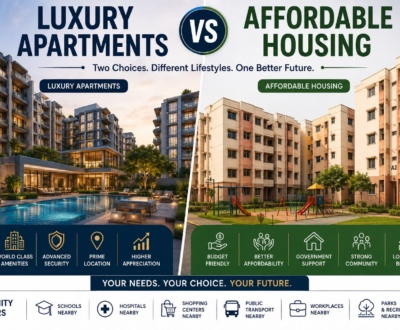
This is where townships clearly pull ahead. Most large townships offer swimming pools, gyms, jogging tracks, kids' play areas, and multi-purpose halls as standard features. Many also include curated retail zones, so you can grab groceries or coffee without ever leaving the gate. For families with young children or elderly parents, this kind of self-contained ecosystem genuinely simplifies daily life.
Standalone apartments, in contrast, usually offer basic amenities at best, maybe a small garden, a lift, and parking. Anything beyond that, like a gym or a pool, becomes a bonus rather than an expectation. However, since standalone buildings sit inside already-developed areas, residents can usually access markets, hospitals, and schools within a short drive, even if these aren't part of the building itself.
## Community and Social Life
Townships naturally build a stronger sense of community. With hundreds or thousands of families living within the same gates, festivals, sports events, and cultural programs become part of everyday life. Kids often grow up with a ready circle of friends right in their building or the next block. For many buyers, especially those relocating to a new city, this built-in social structure removes a lot of the initial loneliness that comes with moving somewhere unfamiliar.
Standalone apartments offer a quieter, more private living experience. You know your immediate neighbors, but there isn't a large, organized social calendar running in the background. Some people genuinely prefer this. Not everyone wants festival committees and community WhatsApp groups buzzing all day.
## Cost Comparison
Price is often the deciding factor, and here, standalone apartments usually come out cheaper. Since developers don't need to build and maintain large shared infrastructure, both the purchase price and the monthly maintenance charges tend to be lower.
Townships, because of their scale and amenities, typically carry a price premium. You're not just paying for your flat; you're paying for your share of the pool, the clubhouse, the security infrastructure, and the landscaped gardens. Maintenance charges in townships can run noticeably higher too, since upkeep of these shared facilities isn't cheap.
If your budget is tight, a standalone apartment might stretch further. If you can afford the premium and actually plan to use the amenities, a township could offer better long-term value.
## Location and Connectivity
Standalone apartments generally win on location. Since they come up within existing city neighborhoods, they're often closer to established workplaces, markets, and transport links. You're buying into infrastructure that already works.
Townships, especially newer ones, often sit on the outskirts of a city, where large parcels of land are available. This means you get more space and greenery, but possibly a longer commute to work or to the older parts of the city. Over time, as the surrounding area develops, this gap tends to shrink, but in the early years, connectivity can be a real concern.
## Privacy and Independence
Standalone apartments offer more privacy in practice. Fewer shared spaces mean fewer forced interactions, and residents generally enjoy a quieter, more independent lifestyle. If you value keeping to yourself, this setup naturally supports that.
Townships, with their community events and shared facilities, come with less privacy by design. You'll likely run into familiar faces at the gym, the park, or the clubhouse regularly. Some buyers love this constant sense of activity around them, while others find it a bit much.
## Security
Both options can offer solid security, but townships generally have an edge due to scale. Large gated campuses often deploy multiple layers of security, CCTV coverage across common areas, and controlled entry points for both residents and visitors. Standalone apartments also maintain security, usually through a security guard and CCTV at the entrance, but the scale and redundancy simply aren't the same as what a township can offer.
## Resale Value and Future Growth
Townships, particularly well-planned ones by reputed developers, often see steady appreciation over time as the surrounding infrastructure matures. The amenities and planned lifestyle also make them attractive to future buyers, which can support resale value.
Standalone apartments, especially those in well-established, centrally located neighborhoods, can also appreciate well, sometimes even faster in the short term, simply because they're already close to everything a buyer wants. Location often matters more than amenities when it comes to long-term resale value, so a well-located standalone apartment can hold its own against a township on the outskirts.
## Which One Should You Choose?
There's no single right answer here. Think about a few honest questions before deciding:
- Do you have young kids or elderly parents who would benefit from on-site amenities and a built-in community?
- Is your budget flexible enough to absorb higher maintenance costs for shared facilities?
- Do you prioritize being close to your workplace and existing city infrastructure over living in a newly developed area?
- Do you enjoy community life, or do you prefer keeping your circle small and your home quiet?
If community, convenience, and lifestyle amenities matter most to you, and your budget allows for it, a township could genuinely improve your day-to-day life. If you'd rather save on costs, stay centrally located, and enjoy a quieter, more independent setup, a standalone apartment might serve you better.
## Conclusion
Township living and standalone apartments both offer valid, comfortable ways to live; they just cater to different priorities. One brings a ready-made community and lifestyle amenities right to your doorstep, while the other offers simplicity, affordability, and closer ties to established city infrastructure. Rather than chasing what seems more popular or premium,
take a step back and think about your own routine, your family's needs, and your long-term plans. The best home isn't the one with the most amenities or the lowest price; it's the one that actually fits how you want to live.
More from our blog
See all posts